Today marks the start of Conversion Centered Design (CCD) week, which includes today’s “Ultimate Guide”, plus 4 more great posts. Together they’ll show you how to apply design and psychology principles to increase the conversion rates of your landing pages.
To give you an overview of what we’ll be covering, check out this list of CCD goodness:
- Monday (today): A free ebook “The Ultimate Guide to Conversion Centered Design” – (68 page PDF)
- Tuesday: 5 Tested Conversion Design Tactics You Should Put to Work. Right Now.
- Wednesday: 36 Creative Landing Page Design Examples – A Showcase and Conversion Critique
- Thursday: How to Design Call-to-Action Buttons That Convert
- Friday: 10 Killer Posts on Conversion & Design
To give you a taste of what’s in the ebook, I’ll introduce the concept and share some of the enlightening case studies and experiments that are included. Enjoy.
What is Conversion Centered Design?
CCD is a discipline targeted at designing experiences that achieve a single business goal. It seeks to guide the visitor toward completing that one specific action, using persuasive design and psychological triggers as devices to increase conversions.
As you’ll see from one of the studies below (the jam experiment), landing pages are the perfect medium to facilitate CCD due to their ‘less is more’ approach. Landing pages use congruent design – having a single collective purpose – to usher your visitors toward the finish line.
The 7 Principles of Conversion Centered Design
The 7 core elements of CCD can be broken down into two groups; design and psychology.
| Design | Psychology |
| Encapsulation | Urgency and Scarcity |
| Color and Contrast | Try Before You Buy |
| Directional Cues | Social Proof |
| White Space |
Each of these is demonstrated through classic design principles, real-world experiments and their practical application using landing pages.
Now let’s talk about some of the psychological experiments in the guide!
Social Proof – The Man Looking Skyward Experiment
In 1969, a study by S. Milgram, L. Bickman and L. Berkowitz, was performed on the streets of New York City in which a man was standing looking up in the air. The goal of the experiment was to see if social proof played a part in the reactions of passersby.

For the single man standing in the street, the study showed most people would walk past him and not pay any attention to what he was looking at. Next up, the experimenters positioned a small crowd of five people, doing the same thing – staring skyward.
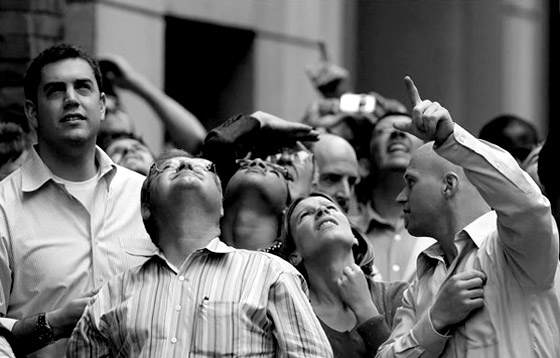
When the group of staring people increased to five, people started reacting by joining in and looking up to see what was going on. Finally, increasing the participants to 18 people resulted in a 400 per cent lift of people stopping to join the crowd. Clearly, the bigger the crowd, the bigger the crowd gets.
Less is More – The Supermarket Jam Experiment

A real world example of the psychology of ‘less is more’ comes from an experiment conducted in a supermarket in 2000 by S. S. Inyengar and M. R. Leper. A jam tasting stall was erected to allow shoppers to sample the different flavors of jam available for purchase. The test compared the impact of varying the number of choices between 24 and 6.
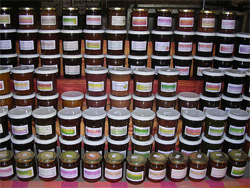
In the case of the 24 flavors, only 3% of those who tasted the samples went on to purchase the jam, compared to a whopping 30% purchase rate when only 6 flavors were available. This demonstrates a phenomenon known as analysis paralysis, where too many options actually results in no decision being made.
This is why landing pages sit at the heart of CCD. They are grounded in a fundamental design pattern that strives to remove distraction and focus visitors on a single targeted conversion goal.
Less is more.
That’s a little teaser of what’s inside the 68-page Ultimate Guide to Conversion Centered Design. Download the full PDF now to learn how to apply the 7 principles of CCD to your landing pages today.